Getting Started with Zodiacology
Getting Started with Zodiacology introduces the essential ideas, language, and structure that can help you begin exploring the natal chart with greater clarity. Start here to understand how Zodiacology approaches the chart as a symbolic framework and how its major components contribute to Your Zodiacal Configuration.
Begin with the Big Picture
Before focusing on individual signs, planets, houses, or techniques, it helps to understand what the natal chart is designed to show. Zodiacology approaches the chart as an interconnected symbolic framework in which multiple factors work together to describe patterns, relationships, emphasis, and potential areas for reflection.
What a Natal Chart Represents
A natal chart is a symbolic map of the sky for a specific moment and place. It brings together the positions of the planets, the signs they occupy, the houses in which they appear, and the relationships formed among them. In Zodiacology, the chart is approached as a whole rather than as a collection of isolated symbols.
How Zodiacology Approaches the Chart
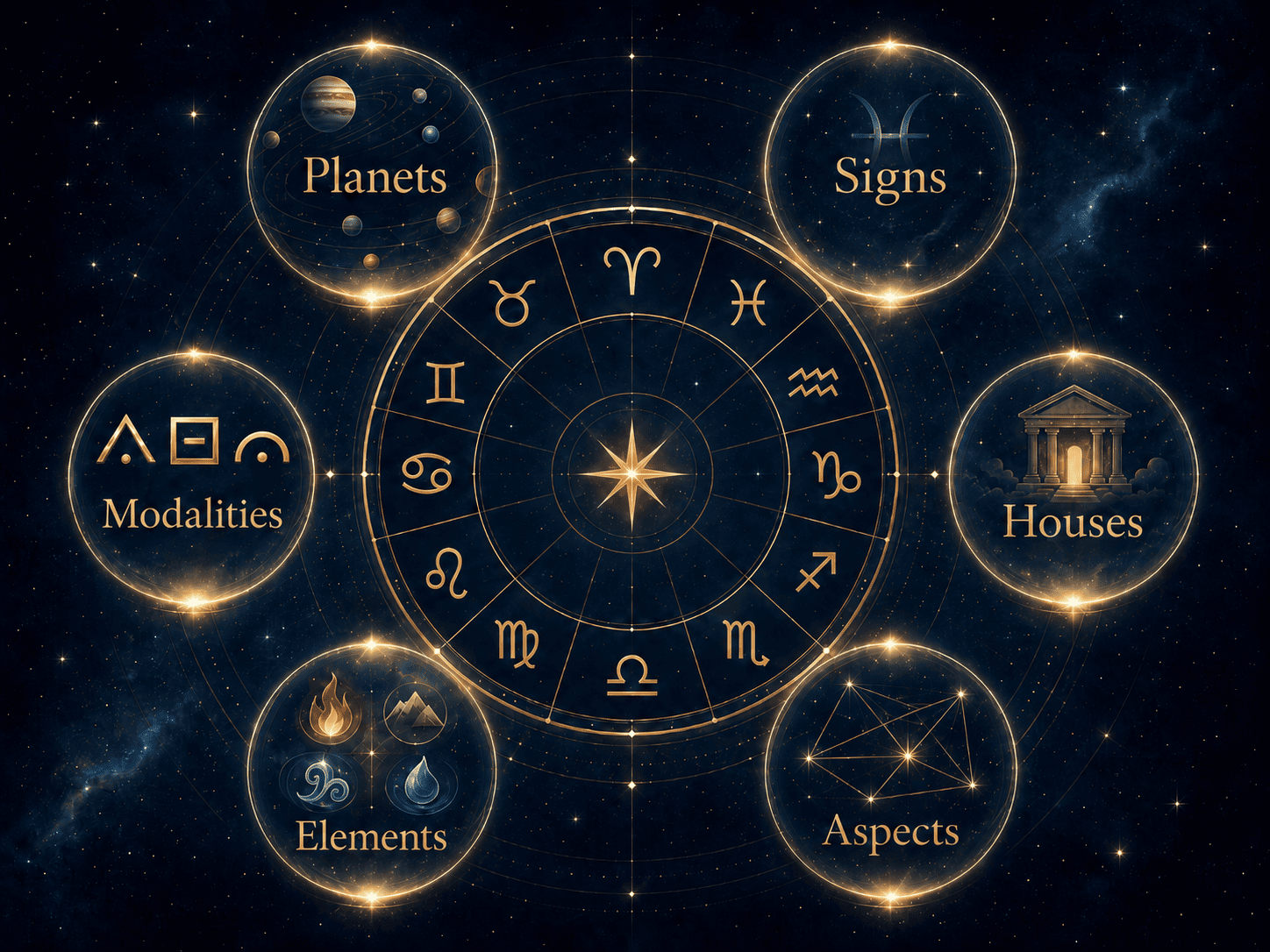
Zodiacology treats the natal chart as an interconnected symbolic framework. Rather than relying on a single placement or simplified label, interpretation develops by considering how signs, planets, houses, aspects, elements, and modalities work together within Your Zodiacal Configuration.
Explore the Six Foundations
The six foundations provide the core vocabulary for beginning chart interpretation. Signs, planets, houses, aspects, elements, and modalities each describe a different part of the chart, but their meaning becomes clearer when they are explored as parts of one connected system.
Signs
Signs describe the style, qualities, and manner through which planetary and chart factors may be expressed. They help show how symbolic energy can take form within Your Zodiacal Configuration.
Planets
Planets represent symbolic functions, drives, and areas of activity within the chart. They help identify what is being expressed and where particular themes may become more prominent within Your Zodiacal Configuration.
Houses
Houses describe the areas of life in which chart factors may become most visible or active. They help show where particular planetary and sign themes may be experienced within Your Zodiacal Configuration.
Aspects
Aspects describe the relationships formed between planets and other chart points. They help show how different symbolic functions may support, challenge, modify, or connect with one another within Your Zodiacal Configuration.
Elements
Elements describe the basic qualities through which symbolic energy may be expressed. Fire, Earth, Air, and Water can help reveal patterns of action, stability, thought, feeling, and overall balance within Your Zodiacal Configuration.
Modalities
Modalities describe how symbolic energy may begin, continue, and adapt. Cardinal, Fixed, and Mutable qualities can help reveal patterns of initiative, stability, flexibility, and movement within Your Zodiacal Configuration.
A Simple Way to Begin
You do not need to understand every part of the natal chart at once. Begin with a clear orientation, learn the six foundations, and then return to the chart as a whole. This sequence can help you build understanding without turning the chart into a collection of disconnected details.
Start with How to Read Your Zodiacal Configuration for an overview of the chart as a whole and an introduction to the six foundational building blocks used throughout Zodiacology.
Use the six foundational pages to explore signs, planets, houses, aspects, elements, and modalities individually. Together, they provide the core vocabulary for understanding how the natal chart is organized and interpreted.
Use Explore Zodiacology to continue beyond the foundations into chart structure, interpretation, timing, relationships, specialized applications, historical traditions, and professional practice.
Continue Exploring Zodiacology
Zodiacology is designed to help you explore the major parts of your Zodiacal Configuration at your own pace. Continue through the foundations, return to the big picture whenever you need it, and use each section to build a clearer understanding of how the pieces relate to one another.